


Software
3 STAAD.Pro Modelling Habits That Save Hours on Every Project
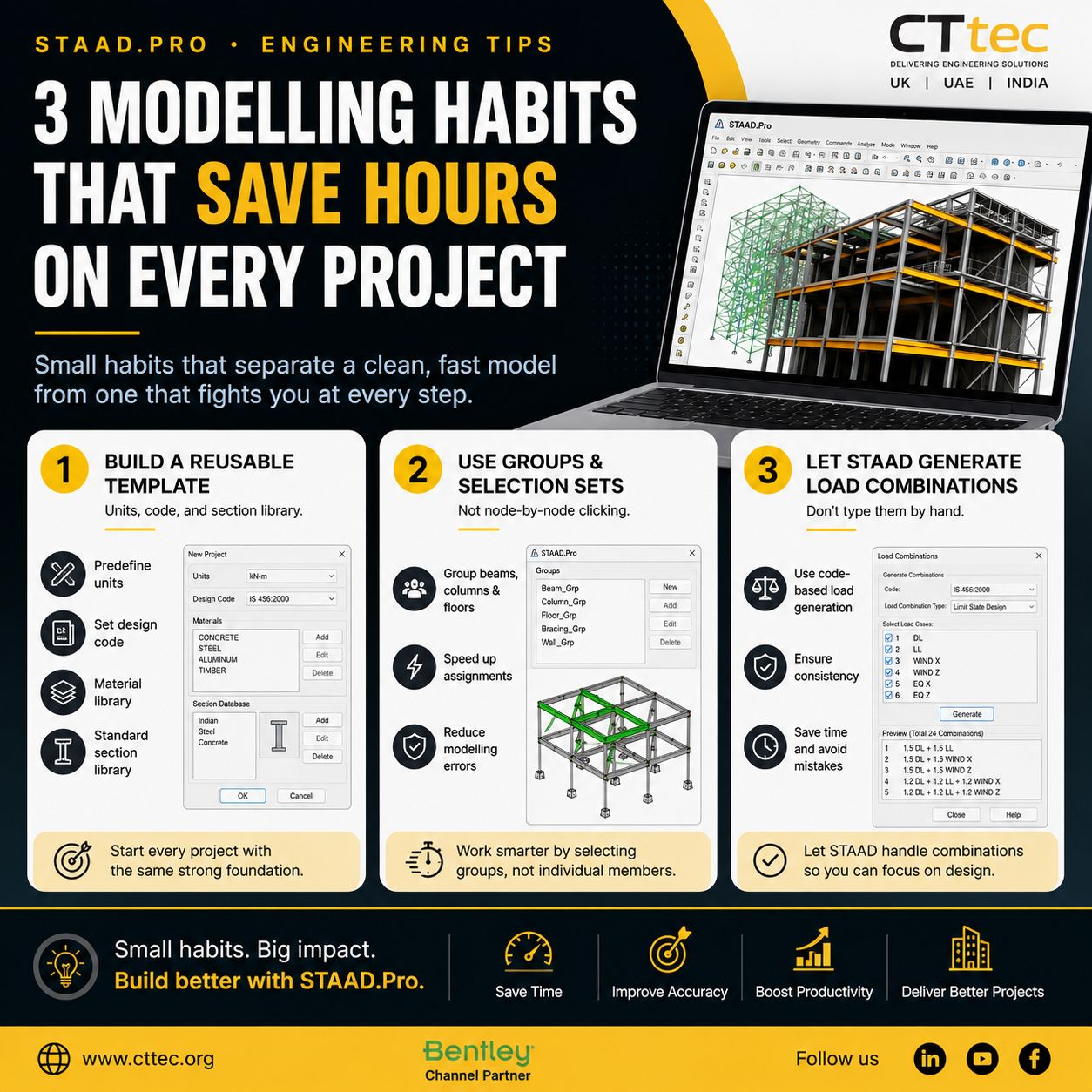
The analysis is the easy part. The time disappears in setup, rework, and chasing errors.
None of these 3 habits are advanced. They’re the ones experienced engineers do without thinking — and the ones that quietly save a day on every job.
- Build a reusable template — units, code, and section library.
- Set your unit system, design code, and a standard section & material library once, then save it as a company template. Rebuilding these on every project wastes time and invites inconsistency between jobs.
- Use groups and selection sets — not node-by-node clicking.
- Group members logically: columns, primary beams, bracing. Assigning loads, applying design parameters, and reviewing results then takes seconds and targets exactly the right members — even in a 20,000-node model.
- Let STAAD generate load combinations — don’t type them by hand.
- Use the built-in load combination generator tied to your design code instead of entering combos manually. Fewer transcription errors, automatic compliance, and instant updates when a single load case changes.
BONUS HABIT: Validate geometry before you solve.
Run the duplicate-node and member-connectivity check, plus a quick self-weight sanity check, before you hit run. Five minutes here saves hours chasing a result that was never going to be right.
To know more about STAAD, write to Support@CTtec.Org.